


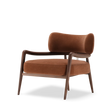
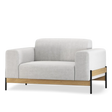
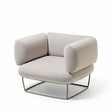
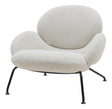
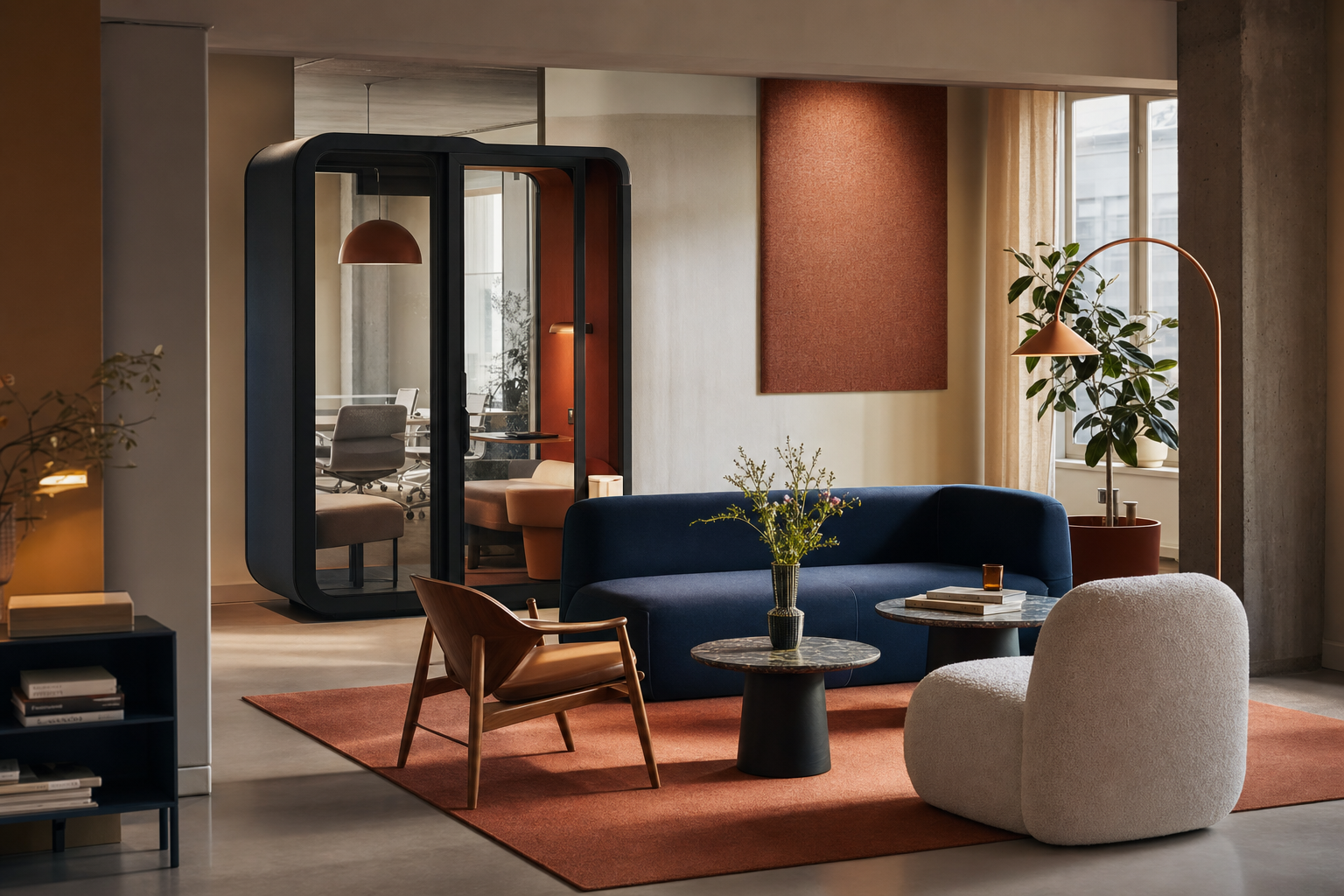
The problem is often readily apparent. The "breakout area" exists on the floorplan, but in practice it's a leftover zone with a sofa, a low table and no real reason to use it. People still book meeting rooms for five-minute conversations, still take calls from circulation space, and still avoid the lounge because it feels decorative rather than useful.
That's where office breakout furniture needs to be treated as a workplace tool, not a styling exercise. The right mix of lounge seating, tables, acoustic elements and power access changes behaviour. It creates places for quick alignment, private conversation, solo decompression and hybrid collaboration without forcing every interaction back to the desk. In the UK, demand for this kind of flexibility is tied to broader workplace change: hybrid patterns mean every in-person day has to earn its commute, and the non-desk settings carry much of that weight.
For buyers comparing options, the question isn't just what to place in a lounge. It's how to specify, fund and recover it properly through models such as circular purchase.
Table of Contents
- Introduction: What Is Office Breakout Furniture?
- The Functional Purpose of Breakout Furniture
- Key Criteria for Specifying Collaborative Office Furniture
- How to Design an Effective Office Breakout Space
- Flexible Procurement Models Beyond Traditional Purchase
- Measuring the Return on Your Breakout Furniture Investment
-
Frequently Asked Questions
- Is office breakout furniture only relevant for large offices?
- What's the difference between breakout furniture and reception furniture?
- Should breakout areas match the desking range exactly?
- When does subscription make more sense than outright purchase?
- What should buyers ask suppliers before shortlisting?
Introduction: What Is Office Breakout Furniture?
Office breakout furniture is the kit of parts that makes non-desk space work. That includes office soft seating, modular sofas, lounge chairs, poseur tables, acoustic booths, side tables, bar stools and power-integrated surfaces. In a good scheme, each piece supports a specific behaviour. Informal conversation. Short solo focus. Quiet recovery. Fast stand-up decisions.
The distinction matters because buyers often start with product type rather than operational purpose. A sofa on its own doesn't create a breakout zone. A properly planned combination does. In practice, the strongest breakout area furniture creates a middle ground between the workstation and the formal meeting room. It helps teams move quickly without turning the whole office into a noisy social lounge.
What breakout furniture should do
A strong specification usually answers four questions:
- Who uses the space: founders, project teams, visitors, hybrid staff, or all of them.
- What happens there: quick check-ins, solo work, waiting, coffee, or private calls.
- How long people stay: five minutes needs a different posture from forty.
- What happens when the team changes: headcount, layout and use patterns rarely stay fixed.
Breakout furniture works when people don't have to think about using it.
That's why office breakout furniture should sit inside the wider workplace plan, not at the end of it. It's closer to behavioural infrastructure than decoration.
The Functional Purpose of Breakout Furniture
A well-zoned breakout area with clear acoustic and visual separation reduces the everyday distractions that push people into meeting rooms for conversations that never needed one. That's the clearest argument for breakout furniture as a functional workplace investment rather than a soft extra.

Collaboration without the friction of formal rooms
The best collaborative office furniture removes small barriers. Teams don't need to find a room, start a booking, or formalise a conversation that should have taken six minutes. A pair of lounge chairs with a small table handles one kind of exchange. A higher shared table with stools handles another. Different postures create different meeting speeds.
That's why breakout zones should never be furnished as if every interaction is the same. Too much low, deep seating slows everything down. Too many upright café pieces make the area feel transactional.
A place to reset still has a business purpose
Good office breakout space design also gives staff a route out of the intensity of the desk without leaving the workplace altogether. That matters in dense open-plan offices where visual movement and constant sound raise cognitive load throughout the day. A breakout space with acoustic separation, softer posture and calmer lighting gives people somewhere to recover between focused tasks.
The cultural signal is visible
Candidates, clients and teams all read the space the same way. If a non-desk zone looks improvised, the message is that informal work doesn't count. If it's organised, powered, comfortable and acoustically considered, the message is clearer. Collaboration is expected, not accidental.
Practical rule: If a breakout area can only support one behaviour, it will be underused.
Key Criteria for Specifying Collaborative Office Furniture
Regulation is moving in one direction here. The EU's Ecodesign for Sustainable Products Regulation (ESPR, 2024/1781) names furniture among its priority product groups, which points toward future requirements on durability, repairability and recyclability. For specifiers, that changes the conversation from surface aesthetics to material logic, disassembly and repair, and voluntary schemes and procurement briefs are already heading the same way with FSC/PEFC timber and OEKO-TEX fabrics where applicable.

Start with movement and wear
Breakout areas are high-touch environments. People drag chairs, shift stools, perch on arms and reconfigure layouts during the day. That means furniture needs to survive constant casual movement without looking tired after a short cycle of use.
For that reason, lightweight but contract-suitable pieces tend to outperform heavier residential forms. Muuto's Outline Sofa and Pedrali's Nolita lounge chairs are often strong choices in breakout zones because teams can move them easily, yet they still hold their shape and visual order after repeated use. In practice, that's one of the clearest differences between true breakout furniture and lounge furniture borrowed from another category.
Specify for repair, not disposal
The most useful material question isn't "Is it durable?" It's "What happens when one part wears out?" Pedrali and Lapalma pieces with replaceable upholstery panels are far easier to keep in service than glued or laminated constructions. Solid European timber with FSC/PEFC certification and powder-coated steel frames also age more predictably and can be refinished or repaired.
A useful benchmark for acoustic desk-adjacent privacy is BuzziSpace's BuzziTripl Desk Split. It uses three layers of 100% recycled PET felt, is 1.45 cm thick, includes powder-coated metal fixes with anti-skid pads, and is fire rated to EN 13501-1. Products like this matter when breakout zones overlap with touchdown work settings and need a softer level of visual and acoustic separation.
A short specification filter
| Priority | What to check |
|---|---|
| Modularity | Can the layout be reworked without replacing the whole set |
| Certifications | FSC/PEFC timber, OEKO-TEX fabrics where applicable |
| Acoustic value | High-back seating, booths, felt partitions, softer surfaces |
| Repairability | Replaceable panels, removable upholstery, refinishing options |
| Visual lifespan | Shapes and finishes that still fit after a wider office refresh |
Cheap breakout furniture often fails in the same place. The upholstery wears first, the frame stays usable, and the whole piece gets discarded anyway.
How to Design an Effective Office Breakout Space
The most effective breakout spaces are zoned by behaviour, not by furniture category. As an illustration, picture a London scaleup that stops routing every informal exchange through one large meeting room and instead builds a breakout scheme around a Muuto Connect modular sofa for soft seating, with two Pedrali Arki-Table poseur tables and Nolita stools nearby. The typical result is that informal alignment happens on the spot instead of waiting for a room booking. That's the same logic behind real projects: at WorkPad's serviced offices in London, the flexible layer of lounge and breakout settings runs on subscription precisely so it can keep following how members actually work.

Build micro-zones, not one lounge
Many office breakout space design schemes go wrong. One sofa group in the middle of a floorplate doesn't create choice. It creates a single social signal. The better move is to create several micro-zones with different heights and levels of enclosure.
A practical layout usually includes:
- Soft seating for slower conversations: modular sofas or lounge chairs that invite short discussion without looking like a waiting room.
- Poseur-height settings for quick decisions: standing or semi-perched postures keep exchanges brief and energetic.
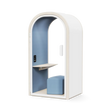
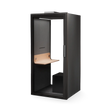
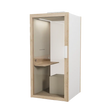
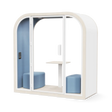
- Acoustic refuge: booths or high-back seating for calls and focused one-to-ones.
- A hospitality edge: a coffee point, water point or snack ledge nearby so the space has a reason to attract traffic.
Track reconfiguration, not just occupancy
One of the strongest practical metrics for breakout furniture is reconfiguration frequency in the first 90 days. If people move chairs, cluster stools and shift lounge pieces, the setting is alive. If nothing moves, the scale, posture or placement is usually wrong.
That's why products such as Pedrali's Nolita chairs tend to work well in active zones. They're easy to reposition, so the furniture can follow the day instead of fixing behaviour too rigidly. For smaller footprints, this logic is close to the principles in modular furniture for small spaces, where every piece needs to earn its place across more than one use.
Flexible Procurement Models Beyond Traditional Purchase
Traditional buying still treats breakout furniture as a fixed asset decision. Specify once, pay upfront, depreciate, replace when the layout no longer fits. That works for some organisations. It's less effective for startups, scaleups, boutique hotels and fast-changing occupiers that need to preserve cash and stay adaptable.

Three models with different financial logic
For breakout area furniture, there are usually three workable routes:
- Circular purchase suits teams that want ownership from day one but don't want end-of-life waste embedded into the decision. Recovery and next-life planning are considered upfront.
- Subscription through FaaS shifts furniture into a more flexible operating model, replacing a large upfront outlay with predictable payments (the exact accounting treatment depends on contract terms, with longer agreements typically recognised under IFRS 16). That's useful when headcount, team structure or office footprint may change.
- Leaseback matters when a business already holds furniture assets and wants to free up capital without stripping the workspace.
According to EME Outlook's profile of Enky, this partnering model combines flexible access with end-of-life recovery to extend product lifecycles and reduce unnecessary new production. For teams evaluating the model itself, Furniture as a Service gives the operational context, while subscription furniture access and circular purchase for owned assets show how the two ownership routes differ in practice.
Operational friction matters too
Furniture procurement isn't only a finance question. It also affects move coordination, storage, replacement cycles and disposal. That becomes obvious during phased office changes, hospitality refits or partial relocations, when handling, interim storage and reinstallation need to be planned as carefully as the furniture itself.
The wrong procurement model can make good furniture behave like a bad investment.
This is the one place where Enky fits directly into the shortlist conversation, because it combines subscription, circular purchase and leaseback in a single operating model rather than forcing buyers into outright purchase only.
Measuring the Return on Your Breakout Furniture Investment
The market context supports the investment case. CSIL values the European office furniture market at more than €9.5 billion in 2025, with rising demand for refurbished furniture, and the categories gaining ground are the ones that solve real spatial problems, privacy and collaboration among them, not purely decorative ones. That tells facilities managers something important about where value now sits.
ROI comes from use, not just unit cost
Cheap breakout furniture can look efficient on a quote sheet and become expensive in operation. It wears unevenly, can't be repaired cleanly, dates quickly and often ends up removed before the rest of the workplace does. The total cost isn't only in replacement. It also sits in downtime, disposal, design inconsistency and awkward underuse of floor area.
By contrast, well-specified breakout furniture tends to return value across several layers:
- Better space utilisation: fewer minor conversations drift into bookable rooms.
- A stronger employee experience: staff have more settings matched to how they work.
- Brand value: clients and candidates read the workplace as coherent and intentional.
- Longer service life: repairable components and recoverable materials reduce waste at refresh stage.
A smarter way to read value
The more useful comparison isn't purchase price versus purchase price. It's rigid CAPEX against adaptable lifecycle value. That's especially true when office breakout furniture sits inside a broader workplace strategy with booths, dividers and touchdown settings working together.
Buyers usually regret two things. Overfurnishing the lounge, or buying pieces that can't evolve with the layout.
Frequently Asked Questions
Is office breakout furniture only relevant for large offices?
No. Smaller offices often benefit more because every square metre has to work harder. A compact breakout area can support quick meetings, solo decompression and overflow collaboration if the furniture is chosen for multiple uses.
What's the difference between breakout furniture and reception furniture?
Reception furniture is primarily front-of-house. Breakout furniture is operational. It needs to support repeated daily use, movement, short meetings, hybrid calls and informal work patterns across the team.
Should breakout areas match the desking range exactly?
Not necessarily. They should relate to the wider interior, but they can shift posture, material and tone to signal a different mode of work. Too much visual uniformity can make the area feel like an extension of the workstation rather than a useful alternative.
When does subscription make more sense than outright purchase?
Subscription tends to make sense when headcount is changing, when a lease term is uncertain, or when a business wants to preserve capital and keep refresh options open. Outright ownership is often better suited to stable layouts with a longer planning horizon.
What should buyers ask suppliers before shortlisting?
Ask how the furniture is repaired, what materials and certifications sit behind it, whether layouts can be reconfigured later, and what happens at end-of-life. If those answers are vague, the furniture probably hasn't been specified for a full lifecycle.
For teams planning a breakout zone that works operationally as well as visually, Enky is worth reviewing alongside the wider shortlist. The catalogue, workspace support and flexible access models are structured around the full furniture lifecycle rather than the initial transaction alone.


