


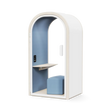
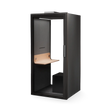
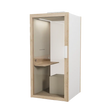
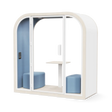
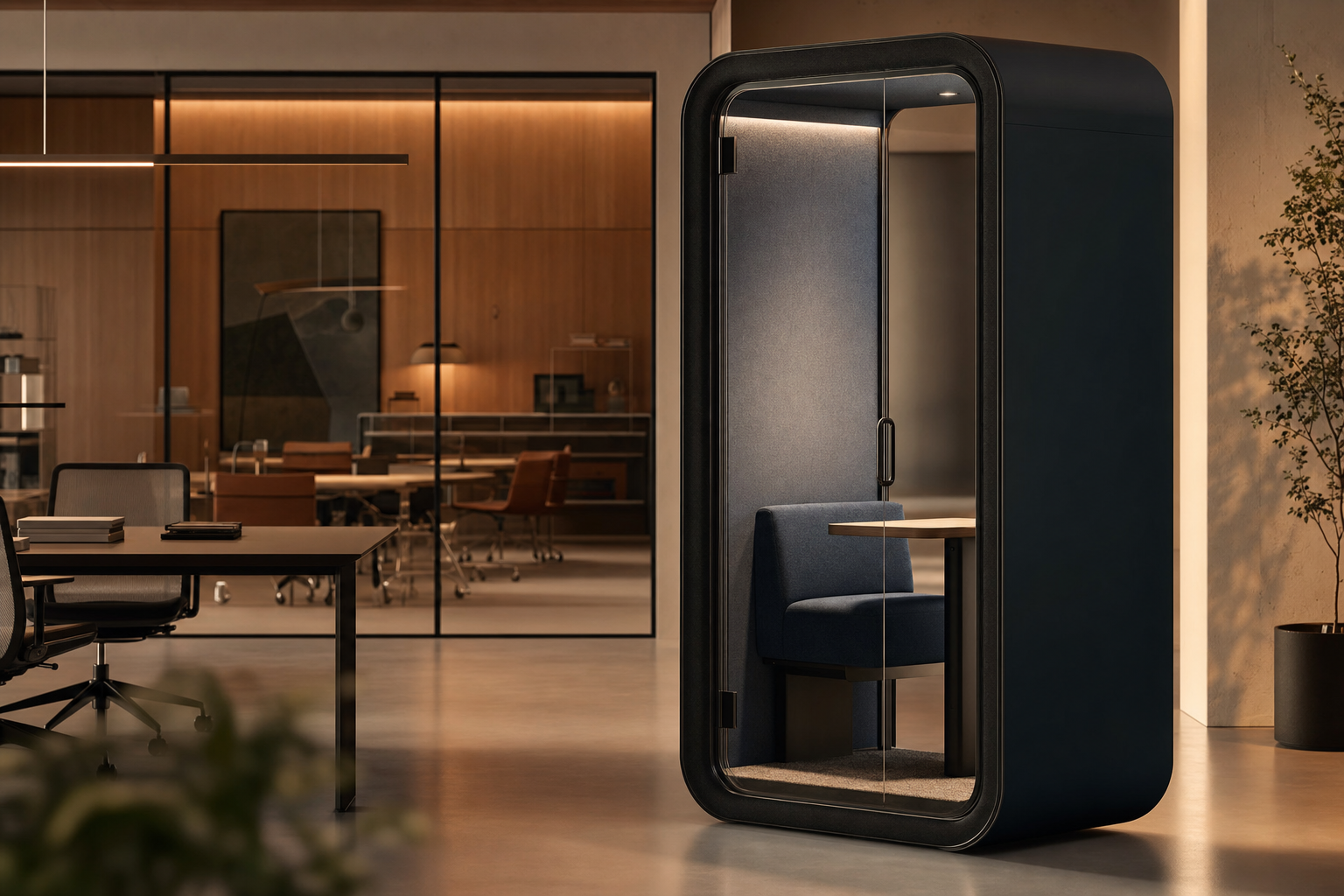
A Framery Pod is rarely bought because someone wants a pod. It's bought because open-plan space has stopped working for calls, focus, and private conversations. On a busy open-plan floor, back-to-back video calls push ambient noise up until concentration starts slipping across whole desk clusters, and the complaint is rarely just volume, it's intelligible speech. That is the problem Framery engineers against: under the ISO 23351-1 standard, a pod's sound insulation is measured as speech level reduction, and Framery's guidance is that a reduction of 30 dB means a pod can sit right next to workstations without the people outside overhearing the conversation inside. That kind of performance is why acoustic pods have become a serious workspace tool, not a decorative extra.
For buyers comparing a Framery pod with other acoustic options, the key question is not whether the unit looks refined. The question is whether it solves privacy, fits the layout, and survives the lease cycle without creating waste or a finance headache. Enky works at that point where design, procurement, and lifecycle planning meet, so the pod is specified alongside desks, storage, and circulation, not dropped into leftover space at the end.
Table of Contents
- Why Open-Plan Offices Need Acoustic Pods
- Choosing the Right Framery Pod Model
- Placement and Spatial Integration Criteria
- Total Cost of Ownership and Flexible Access Models
- Circular Procurement and End-of-Life Recovery
- Common Questions About Framery Pods
Why Open-Plan Offices Need Acoustic Pods
A 50-person scale-up doesn't usually fail because the desks are wrong. It fails because the office can't absorb modern work patterns, back-to-back video calls, ad hoc huddles, and private conversations all happen in the same acoustic field. When the floor is busy with calls, people stop hearing themselves think, and standard soft finishes only partly help.

What the pod solves that soft finishes don't
Ceiling baffles, carpet tiles, and upholstered panels all help reduce reflected noise, but they don't create speech privacy. That matters because call disruption is usually caused by intelligible voices, not just volume. A soundproof office booth changes the problem by creating a defined acoustic zone, so the person inside can speak normally without broadcasting into the room.
Practical rule: if colleagues can still understand words from a phone call, the office hasn't solved privacy, it has only softened the room.
A Framery pod works best when the office already has the right open-plan density but lacks private acoustic space. It's not a replacement for good planning, it's the corrective piece that handles the gaps left by the layout, and the ISO 23351-1 speech level reduction figure is what tells you whether the pod can genuinely sit inside the working floor rather than being exiled to a quiet corner.
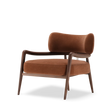
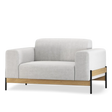
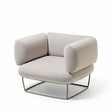
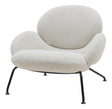
Enky treats that result as part of a wider fit-out, not a one-product fix. A pod can sit alongside Pedrali tables, Muuto soft seating, or Alki lounge pieces, so the acoustic intervention reads as part of the same workplace language rather than a foreign object dropped into a shared area.
Choosing the Right Framery Pod Model
The current Framery range isn't interchangeable, and treating it that way causes avoidable overspend or underperformance. Framery One is the smart, soundproof one-person pod for video calls and focus work, while Framery Four and Framery Six move into small meeting and hybrid collaboration use. The model choice should follow occupancy first, then power and floor constraints. Framery's own sizing guidance is a useful starting ratio: one Framery One or One Compact for every 10 employees, one Framery Four for every 20, and one Framery Six for every 30, with more pods needed where ad hoc calls dominate.

Match the model to the task
A single-user workstation is a different asset from a four-person call room. The electrical load alone makes that obvious. Framery One defaults at 28 W and peaks at 37 W, while Framery Four and Four Accessible sit at 52 W / 115 W, and Framery Six at 145 W / 202 W, all with 100-240 VAC input and 50-60 Hz compatibility, according to Framery's own FAQ. Larger pods need more circuit capacity and tighter coordination with building M&E teams.
| Framery Pod Model Comparison | Occupancy | Default/Peak Load | Primary Use Case |
|---|---|---|---|
| Framery One | 1 person | 28 W / 37 W | Focus work, video calls |
| Framery One Compact | 1 person | 27 W / 40 W | Compact private work |
| Framery Four | 1-4 people | 52 W / 115 W | Small meetings, hybrid calls |
| Framery Four Accessible | 1-4 people | 52 W / 115 W | ADA-compliant accessible meeting use |
| Framery Six | Up to 6 people | 145 W / 202 W | Larger team sessions |
The smart pod range launched in March 2024, and the older O, Q, and 2Q models were phased out of production by the end of that year, so buyers should focus on the current smart range rather than legacy stock. For a team that mostly needs heads-down calls, a one-person pod is the sensible choice. For a project room or weekly catch-up space, the larger formats are the better fit.
The exact product page for the current single-user model is Framery One, and that matters because the pod is only useful when the specification matches the actual occupancy pattern. A Calipso Seat Module can complement a lobby or breakout area visually, but it doesn't replace private acoustic space. Different furniture solves different problems.
Placement and Spatial Integration Criteria
The most common integration failure is simple. A pod gets placed where there is leftover floor area, not where people move. That creates awkward door swings, poor circulation, and a pod that looks like a bolt-on device instead of part of the room. The fix starts long before delivery, and it matches Framery's own placement guidance, which recommends locating pods centrally, close to where people work, so it's easy to see whether a pod is free and easy to step inside.
Three checks that should happen before ordering
First, review the occupancy pattern. A room used mainly for 1:1 focus calls needs a different pod than a space serving hybrid meetings or quick huddles. Second, check floor load and ventilation access. Pods are heavy, a Framery One weighs over 350 kg, and older buildings in hospitality or co-living often need careful floor verification and a clear path to power and airflow. Third, map acoustic zoning against the existing layout so the pod sits away from HVAC returns and near natural traffic flow.
A pod is used more when it sits on the route people already take, not when it hides in a corner nobody passes.
The same logic extends to hospitality. Pods can be specified in finishes and upholstery that match a property's palette, so the unit reads as a designed guest business nook rather than an office import, and visual continuity is preserved as the wider interior evolves.
The same principle applies to larger fit-outs. Pod placement needs to happen at the same stage as desks and storage, ideally with the architect or design partner in the loop. Enky does that across projects, then aligns the pod with surrounding furniture so the room feels coherent. In a mixed workspace, that may mean a Framery pod near circulation, Pedrali tables for collaborative zones, and storage positioned so the acoustic booth doesn't fight the room's flow.
Total Cost of Ownership and Flexible Access Models
The purchase price is only the visible part of the bill. A Framery pod also brings delivery, installation, maintenance, relocation, and energy use into the total cost of ownership, and those items are often what swing the decision. For a startup, that changes the finance conversation from CAPEX only to a mix of CAPEX and OPEX.

How the access model changes the decision
Enky structures the choice three ways. Circular purchase gives ownership from day one with end-of-life recovery included. Subscription, or FaaS, gives monthly access with an option to buy. Leaseback releases capital, up to 90% of the furniture's value, from furniture already on site while keeping the asset in use.
That is where a procurement team can separate a one-time buy from a lifecycle decision. A growing software team might prefer subscription to preserve cash flow. A hospitality operator might use circular purchase to avoid a CAPEX spike while keeping recovery and redistribution built in. A landlord-led refurbishment might favour leaseback where existing furniture can stay productive instead of sitting on the balance sheet.
The hybrid-work context matters too. ONS data shows that more than a quarter of working adults in the UK now do at least some work from home. That doesn't eliminate the office, it makes acoustic space more selective. Teams need private space when they come in, but they don't need a fixed room count that never changes.
Enky's FaaS approach applies that logic to acoustic pods, with the furniture treated as an active asset over time rather than a sunk cost.
Circular Procurement and End-of-Life Recovery
A pod should be treated as a recoverable asset, not a disposable fit-out item. That matters in the UK because the UK Green Building Council puts buildings and construction at around 25% of UK greenhouse gas emissions. Once a product enters the office, the procurement decision needs to cover reuse, disassembly, and relocation as well as acoustics.
Why circularity is a procurement issue, not a branding issue
Circular buying changes the exit plan from day one. Enky's circular purchase model includes end-of-life recovery and next-life redistribution when a contract ends or a team relocates, and its overview of circular economy furniture sets out the same principle in broader furniture terms. That is practical for landlords, scaleups, and hospitality operators that may move before a pod has reached the end of its physical usefulness. It also supports internal sustainability reporting, because the asset stays in circulation instead of being written off too early.
The product supports that strategy from the manufacturing side. Framery engineers its smart pods for durability measured in decades, with modular, replaceable parts that allow refurbishment for a next life, reports 95.7% material efficiency in production, and cites a 2024 study finding its pods are on average 30% less carbon-intensive than built rooms over their life cycle (Framery FAQ). The company itself was founded in 2010 in Tampere, Finland, where all products are manufactured, with customers in over 100 countries supported through a global reseller network (Framery company page). That setup matters because a pod is easier to recover, service, and place into another fit-out cycle when the maker can support it consistently.
For UK buyers, the key question is simple. Does the pod fit the building today, and can it be reconfigured or recovered when the office changes? That is the difference between a circular asset and one that becomes stranded after the first lease.
Common Questions About Framery Pods
Do Framery pods really meet acoustic expectations?
Framery publishes its sound insulation performance under the ISO 23351-1 speech level reduction standard, and independent coverage in Stuff highlights that soundproofing as the core of the product. In practice, the result depends on correct placement and installation as much as the product itself.
Can a Framery pod be customised for a hospitality project?
Yes. Pods can be specified in finishes and upholstery that match an interior palette, so the unit reads as part of the guest experience rather than a workplace import. That kind of finish choice is useful where brand cohesion matters more than a standard catalogue look.
What happens at the end of a lease or when an office relocates?
That depends on the access model. Enky's circular purchase includes recovery and redistribution, while subscription and leaseback give different levels of flexibility depending on the project timeline and asset strategy.
How does a pod compare with other acoustic furniture choices?
A pod solves privacy, not just softness. Modular seating, such as pieces from Pedrali or Muuto, helps the broader fit-out, but a Framery pod is the dedicated acoustic room for calls and focus work. They work best together, not as substitutes.
For teams planning an office, hotel, or co-working fit-out, the right pod decision starts with layout, finance, and lifecycle planning, not just product selection. Enky can supply a Framery Pod through subscription, circular purchase, or leaseback, then integrate it into a wider furniture scheme that works in use. For a project discussion or to review the acoustic phone booth range, visit Enky and start from the space, not the SKU.


