



Sustainable Office Design: A Circular Furniture Guide
Traditional fit-outs still treat furniture as disposable. That's the wrong starting point for sustainable office design. Defra's official statistics show that the UK generated 222.2 million tonnes of waste in 2018, with construction, demolition and excavation accounting for 62% of it, around 138 million tonnes. A facilities manager feels that waste problem in practical terms: strip-out costs, rushed procurement, mismatched furniture lifecycles, and layouts that become obsolete before the lease does.
Sustainable office design works when it shifts the conversation from isolated product choices to whole-life decisions. Materials matter. Energy systems matter. But procurement model matters too, because the choice between buying new, subscribing, or recovering existing assets determines how much new production a project triggers.
For teams planning a fit-out or reconfiguration, the useful question isn't whether a chair contains recycled content. It's whether the full workspace can stay adaptable, traceable, and recoverable over time. Practical workspace planning, furniture selection, and circular access models all sit inside the same decision. That's why high-intent projects usually start with workspace solutions for evolving offices, not a product spreadsheet.
Table of Contents
- The Core Principles of Sustainable Office Design
- Selecting Certified Materials and European Brands
- Designing for Energy Efficiency and Flexible Use
- How Circular Procurement Models Reduce Embodied Carbon
- Calculating the ROI of a Sustainable Workspace
-
Frequently Asked Questions about Sustainable Fit-Outs
- Isn't sustainable furniture just more expensive?
- What is the real carbon impact of choosing subscription over buying new?
- How does leaseback work and why is it sustainable?
- What should a facilities manager ask suppliers before approving an eco-friendly office furniture package?
- Does modular furniture really make a measurable difference?
- Conclusion
The Core Principles of Sustainable Office Design
The useful definition of sustainable office design starts with lifecycle thinking. A fit-out isn't sustainable because it looks natural, uses muted colours, or includes one recycled finish. It becomes sustainable when each design choice lowers material intensity, extends product life, and reduces future strip-out.

Reduce through fewer interventions
The first principle is reduce. That means limiting unnecessary construction, avoiding bespoke elements that can't move with the business, and cutting the volume of furniture that will be replaced early. For a facilities team, this often starts with a blunt audit: what can stay, what can be repaired, and what needs replacing.
Reuse before replacing
The second principle is reuse. Here, sustainability in office design becomes commercially credible. Existing meeting tables, storage, or task seating often have years of functional life left. The scale of the missed opportunity is well documented: WRAP, the UK's circular-economy body, estimates that the UK discards around 1.2 million desks and 1.8 million chairs every year, and that only about 17% are recycled. If the space plan changes, a recovered or refurbished item usually creates less waste than ordering a new equivalent.
Practical rule: If a piece can be repaired, reupholstered, or reassigned to another zone, replacement should be the exception, not the default.
Recycle and regenerate with intent
The third and fourth principles are recycle and regenerate. Recycling matters most when reuse is no longer possible. Regeneration matters when design decisions improve the day-to-day quality of the space, especially through material health, daylight, and air quality. Low-impact design fails if indoor conditions remain poor, so ventilation, acoustics, and lighting belong in the same conversation as materials.
A circular office doesn't rely on a single green label. It relies on disassembly, repairability, and a plan for what happens at end-of-life.
Selecting Certified Materials and European Brands
Material claims are where many sustainable office fit-out projects go off track. "Eco-friendly" is too vague to specify, too weak to verify, and too easy to misuse in procurement. Certification is the filter that keeps the shortlist honest.

Why certification matters in practice
For most workspace briefs, OEKO-TEX and FSC/PEFC are the certifications that carry the most operational value. OEKO-TEX helps teams show material safety in upholstered products and textiles. FSC/PEFC helps prove responsible timber sourcing, which matters in corporate reporting and landlord reviews.
Regulation is moving the same way. The EU's Ecodesign for Sustainable Products Regulation names furniture as a priority product group for durability, reparability and recycled-content requirements, so documented, certified materials are becoming a compliance question as much as a brand one.
A practical specification usually favours manufacturers that can provide full material declarations, not just front-end certificates. That traceability issue is where many low-cost alternatives fail.
Brand selection should support traceability
European brands such as Pedrali, Alki, and Muuto are often easier to specify in sustainable office building design because the documentation tends to be clearer and the manufacturing standards more consistent. A facilities manager doesn't need abstract sustainability messaging. A project team needs timber provenance, textile certification, repair pathways, and confidence that replacement components can still be sourced later.
For readers comparing manufacturers, Enky's brand directory provides a useful view of the types of European-made collections commonly specified across workspace and hospitality projects.
A boutique hotel lounge and a hybrid office reception often face the same requirement: attractive seating that also satisfies material-safety scrutiny. That's where certified upholstery and documented sourcing stop being a marketing detail and become a procurement requirement.
Designing for Energy Efficiency and Flexible Use
For most occupiers, the fastest operational win in sustainable office design comes from lighting and controls. Daylight harvesting, occupancy sensors, and LED systems prevent waste every working day, which is why the best sustainable fit-out decisions aren't always the most visible ones.
Flexible furniture prevents future strip-out
A rigid layout ages fast. A modular one usually doesn't. Freestanding desks, moveable meeting tables, modular sofas, and acoustic elements allow teams to reconfigure without rewiring, demolition, or another procurement cycle. For a growing startup moving from heads-down work to hybrid collaboration, that flexibility often saves more waste over time than one premium finish ever could.
A layout that can change without reconstruction is usually more sustainable than one that looks sustainable on day one.
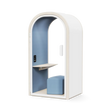
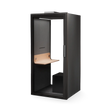
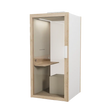
Brands such as Lapalma and Softline suit this logic because modularity can support both workplace and hospitality settings. Framery phone booths add another operational layer. They improve acoustic privacy without forcing teams into permanent partitioning, which is useful when occupancy patterns remain uncertain.
Energy efficiency and furniture planning should be coordinated
Facilities teams often treat electrical upgrades and furniture specification as separate workstreams. That creates friction later. Occupancy sensors, lighting control, circulation planning, and acoustic zoning all work better when planned together: a furniture layout fixes where people sit, move, and gather, and the building systems should follow that logic rather than fight it.
The same long-life thinking extends to mixed-use terraces, rooftop lounges, and hospitality-adjacent breakout spaces, where modular pieces designed for durability outlast fixed installations that have to be stripped out when the concept changes.
How Circular Procurement Models Reduce Embodied Carbon
Most guidance on sustainable office design focuses on materials. Procurement model deserves equal weight, because it determines whether a project creates demand for entirely new furniture or keeps existing assets in circulation. The scale is European, not local: research by Eunomia for the European Environmental Bureau estimates that around 10 million tonnes of furniture are discarded in the EU each year, most of it landfilled or incinerated. Every piece kept in circulation is production, logistics, and disposal that never happens.
Three models, three different sustainability outcomes
A 50-person startup opening a first permanent office is a good example. If headcount is uncertain, buying every workstation, meeting chair, lounge seat, and storage unit outright may lock the business into the wrong asset profile. A subscription model can align better with fluctuating occupancy. If the team grows, pieces can be added. If the layout changes, the furniture mix can change too.
Circular purchase works differently. The business owns the furniture from day one, but end-of-life recovery is built into the model. That matters because ownership without a recovery pathway often ends in ad hoc disposal. For teams that need balance-sheet clarity and long-term use, circular purchase is often the cleaner route.
Leaseback solves another problem. Some occupiers already hold furniture assets that still have use value but tie up capital. Leaseback lets them release that capital while keeping the furniture in operation, which is both a cash-flow decision and a circular economy decision.
| Criteria | Circular Purchase | Subscription (FaaS) | Leaseback |
|---|---|---|---|
| Ownership at start | Client owns from day one | Provider retains ownership during term | Existing assets are monetised while remaining in use |
| Budget logic | CAPEX with end-of-life recovery | Regular payments with flexibility to scale | Releases capital from existing furniture |
| Best fit | Stable layouts with long planning horizon | Growing teams and uncertain occupancy | Businesses with usable furniture already in place |
| Sustainability effect | Avoids disposal through planned recovery | Reduces overbuying and supports redistribution | Extends asset life instead of replacing usable stock |
The models also combine. At Momoamo's Domaine de Courtigis, a corporate-retreat estate just over an hour from Paris with five renovated buildings and seven meeting spaces, we paired a circular purchase for the permanent anchor pieces with a subscription layer that can be refreshed or reconfigured as the concept evolves. The result is design consistency without locking every piece into ownership, and no waste generated when the space changes.
Circularity depends on recovery, not intention
Subscription, or FaaS, only works as a sustainability lever if maintenance, retrieval, refurbishment, and redistribution are operationally built in. Otherwise it's just rental. The same is true of circular purchase and leaseback. A circular office furniture strategy fails when there's no route for repair, reassignment, or next-life use.
The procurement model is part of the design brief. If recovery isn't planned at the start, it usually won't happen at the end.
For teams evaluating upfront purchase against pay-as-you-use access, subscription furniture access and circular ownership models are practical ways to connect cash-flow flexibility with lower embodied impact.
Calculating the ROI of a Sustainable Workspace
The financial objection to sustainable office design is usually framed too narrowly. Decision-makers compare upfront fit-out cost and stop there. The better question is what the space costs over its full operating life, including energy, churn, reconfiguration, and employee performance.
The stakes justify the wider frame: the UK Green Building Council attributes around a quarter of the UK's carbon emissions to the built environment. For an occupier, that makes the workspace one of the most direct levers a business holds over its own footprint, and it links environmental impact directly to operating economics.

ROI is wider than utilities
The strongest business case usually combines three layers:
- Operational savings: lower lighting and energy spend, fewer disruptive reworks, and less waste handling.
- People performance: healthier materials, better air quality, and stronger acoustic planning support day-to-day concentration.
- Asset strategy: furniture that can be recovered, reused, or reallocated keeps value in the system longer.
That third layer is where standard fit-out calculations often miss the mark. If an occupier expects portfolio changes, mergers, or hybrid shifts, the ability to avoid a future strip-out can matter as much as the first-year budget.
Carbon and capital should be reviewed together
The biggest carbon shift comes when a chair, desk, or meeting table gets a second life instead of triggering new production, because avoided manufacturing and logistics dwarf most other levers an occupier controls. By keeping high-quality furniture in circulation across our projects, our model has helped avoid an estimated 1,990 tonnes of CO2e emissions. The figure is an internal estimate, but the direction is the point: reuse beats replacement on carbon almost every time.
A finance team assessing asset use might also review leaseback options for existing furniture portfolios, especially where usable furniture is sitting on the balance sheet but no longer matches current capital priorities.
A sustainable workspace pays back fastest when the brief includes fewer replacements, fewer rebuilds, and fewer stranded assets.
Frequently Asked Questions about Sustainable Fit-Outs
Isn't sustainable furniture just more expensive?
Not always in whole-life terms. Some sustainable office building design choices do carry a higher upfront cost, particularly where certification, energy systems, or premium durable materials are involved. But cost should be assessed against service life, adaptability, operating savings, and recovery value, not just the initial invoice.
What is the real carbon impact of choosing subscription over buying new?
The impact depends on whether subscription includes genuine circular operations. If furniture is maintained, collected, refurbished, and reassigned, subscription can reduce unnecessary new production and prevent overbuying when headcount changes. If those processes don't exist, the sustainability case weakens quickly.
How does leaseback work and why is it sustainable?
Leaseback allows a business to access capital from furniture it already owns while keeping those assets in use. From a sustainability perspective, that matters because the business avoids replacing usable stock solely to address a finance problem. It supports both circular office furniture strategy and cash-flow management.
What should a facilities manager ask suppliers before approving an eco-friendly office furniture package?
Four questions usually reveal the quality of the offer:
- What certifications are documented: Ask for OEKO-TEX and FSC/PEFC evidence where relevant.
- How are repairs handled: Replacement culture is expensive and wasteful.
- What happens at end-of-life: Recovery, refurbishment, or redistribution should be defined in writing.
- How traceable is the supply chain: Surface-level claims aren't enough if foam, adhesives, or finishes remain opaque.
Does modular furniture really make a measurable difference?
Yes, operationally it often does. A modular layout lets teams adapt meeting zones, touchdown areas, acoustic settings, and lounge space without demolition or wholesale replacement. In practice, that reduces the material and labour burden of every future change.
Conclusion
Sustainable office design isn't a styling exercise. It's an operating model for reducing waste, controlling lifecycle cost, and keeping furniture in use for longer. The strongest projects combine certified materials, flexible layouts, and circular procurement so the fit-out can evolve without starting over.
For teams planning a workspace, hospitality, or mixed-use project, Enky offers a practical route into circular furniture strategies, from subscription and circular purchase to leaseback, with European-made collections designed for durability, recovery, and long-term use.


