







Office Interior Fit Out: A Practical UK Guide for Operators
A good office interior fit out starts before a single chair is ordered. The central question is not what the floor will look like, it's how the FF&E line is funded, sequenced, recovered, and aligned to the lease term so the project doesn't turn into avoidable capital strain after the contractor is already on site. In the UK, that matters more than ever, because fit-out costs remain structurally high, office supply is tight, and occupiers are being pushed to make sharper decisions about reuse, relocation, and specification.
Table of Contents
- The Procurement Decision Most Fit-Out Guides Miss
- Four Fit-Out Phases from Briefing to Practical Completion
- What UK Fit-Out Costs Actually Look Like in 2026
- Subscription, Circular Purchase or Leaseback for the FF&E Line
- Zoning the Specification for Hybrid UK Workplaces
- Certified European Furniture as a Risk-Reduction Tool
- Build, Snagging, Handover and End of Life Recovery
The Procurement Decision Most Fit-Out Guides Miss
Most office interior fit outs are still briefed as design exercises, then managed as procurement problems once the programme is already fixed. That order creates friction, because furniture is usually the last line to be discussed even though it affects lead times, capex exposure, and what happens at lease exit. The better sequence is to treat furniture as a procurement decision first, then let design, logistics, and recovery follow that decision.

Practical rule: if the lease term, refurbishment cycle, and exit position are unclear, the furniture strategy is already under-specified.
That is why FF&E should be read as a managed asset line, not a decorative finish. A furniture package can be structured as subscription, circular purchase, or leaseback, and each option changes who carries residual risk, who pays upfront, and how the board sees the spend. For UK operators, that can convert a large capital exposure into a predictable operating line without touching the contractor's main programme or the core build scope.
The rest of the process works better when the FF&E line is followed through the same logic as the rest of the fit-out. Brief, specification, procurement, install, and recovery all behave differently once the furniture is treated as something that has a lifecycle, not just a delivery date.
Four Fit-Out Phases from Briefing to Practical Completion
Briefing and feasibility
The first gate is not mood boards, it's space strategy. The brief should lock together lease term, refurbishment cycle, headcount assumptions, and accessibility duties under the Workplace (Health, Safety and Welfare) Regulations 1992 and related access requirements, because a fit-out that ignores those basics usually gets corrected later at cost. The British Council for Offices treats fit-out as an end-to-end operational journey, from material selection to how space is managed in use, which is the right frame for an operator-led programme.
At this point, the decision maker is usually the workplace lead, backed by facilities, finance, and the project manager. If the lease term is three years and the intended reconfiguration cycle is short, the furniture structure should already be leaning toward lower residual exposure. If the building is staying longer, more of the value case sits in ownership, recovery, and reuse.
Concept, design, and technical documentation
Once feasibility is agreed, design can move into zoning, finishes, and the furniture schedule. That stage should be built around the actual working pattern, not an imagined full-time occupancy model. The BCO's July 2025 report on post-pandemic UK office utilisation, authored by Nigel Oseland of Workplace Unlimited, revised the long-standing workstation utilisation benchmark down from 80% to 66%, which it translates to an effective density of 15 square metres per occupant, up from 12.5 square metres. The implication is simple, occupancy modelling has to come before workstation counts, circulation, and MEP loading.
The technical pack then needs to hold together with the contract route, often under a JCT-style procurement framework, while the team resolves fire, access, and ventilation approvals. A good operator keeps the architect, MEP engineer, landlord rep, and furniture specifier in the same room before the tender goes out. That avoids late substitutions that look harmless on paper and become snagging problems on site.
Build and practical completion
During build, the furniture programme has to be sequenced against landlord access, trade handovers, and final installation windows. The fit-out lead should be checking whether delivery dates still align with the Category B handover and whether storage, access, and lift use have been agreed in writing. Once that is clear, practical completion becomes an operational closeout rather than a scramble.
The same principle applies across the whole package: flooring, partitions, and FF&E need to be coordinated rather than treated as separate silos, because once one trade slips, the others inherit the delay.
What UK Fit-Out Costs Actually Look Like in 2026
A live brief in London still starts with the cost envelope, and that envelope is wider than many teams expect. Cushman & Wakefield's 2026 office fit-out guide places all-in fit-out costs at roughly £148 to £359 per square foot in London, against £117 to £295 per square foot across Glasgow, Birmingham, and Manchester. The useful reading is simple, UK office fit-out costs have not returned to pre-pandemic levels, so a budget built on old assumptions will miss the mark.
| City | Low (£/sq ft) | High (£/sq ft) |
|---|---|---|
| London | £148 | £359 |
| Manchester | £128 | £310 |
| Birmingham | £121 | £295 |
| Glasgow | £117 | £284 |
Within that envelope, FF&E is typically one of the largest single lines on a furniture-heavy hybrid scheme, alongside M&E and partitions. That is where many office interior design UK conversations go wrong, because the visible finishes get discussed first while the primary cost pressure sits in the specification mix.
The spread between cities stays significant, which is why early specification choices matter. A premium sustainability-led scheme with circular furniture and exposed services will not price like a stripped-back Cat B floor. The BCO's updated utilisation benchmark helps turn that into desk planning, because budget should be tested against the number of people the office is designed to support, not a theoretical full headcount.
Subscription, Circular Purchase or Leaseback for the FF&E Line
The right furniture structure depends on the lease term and how often the space is expected to change. Subscription suits occupiers who want one monthly OPEX line and a clean exit, especially where the lease horizon is short and replacement risk needs to be wrapped into the monthly fee. Circular purchase fits operators who want ownership but also want the furniture specified for recovery and refurbishment at a later date. Leaseback sits between the two, because it releases up to 90% of the furniture's value as capital while keeping the assets in use.
| Criterion | Subscription | Circular purchase | Leaseback |
|---|---|---|---|
| Upfront cash exposure | Low | Higher than subscription | Converted into monthly cost after sale |
| Residual risk | Managed by provider | Shared through recovery structure | Reduced after sale and leaseback |
| Best fit | Shorter occupancy, flexible exits | Longer use, planned reconfiguration | Capital-sensitive teams with owned assets |
| End-of-life position | Clean return route | Recovery and recirculation | Repurchase or return depending on exit terms |
| Programme impact | Can simplify approval | Needs stronger spec discipline | Keeps cash available for other scope |
A workplace lead should read these models against dilapidations, not just against a furniture quote. If the fit-out is likely to be reworked before the lease ends, ownership without a recovery plan usually becomes expensive at exit. If the office is intended to stay stable, subscription can be the cleanest way to keep the FF&E line off the capital request and inside a predictable operating budget.
The same logic explains why the procurement structure needs to be settled early. A furniture subscription model such as Enky's can sit alongside a contractor programme without changing the build scope, but it changes how the cost is approved and how the assets are handled later. For operators comparing structures, Enky's Furniture as a Service reference helps frame the discussion around cash flow, ownership, and recovery rather than around product alone.
Zoning the Specification for Hybrid UK Workplaces
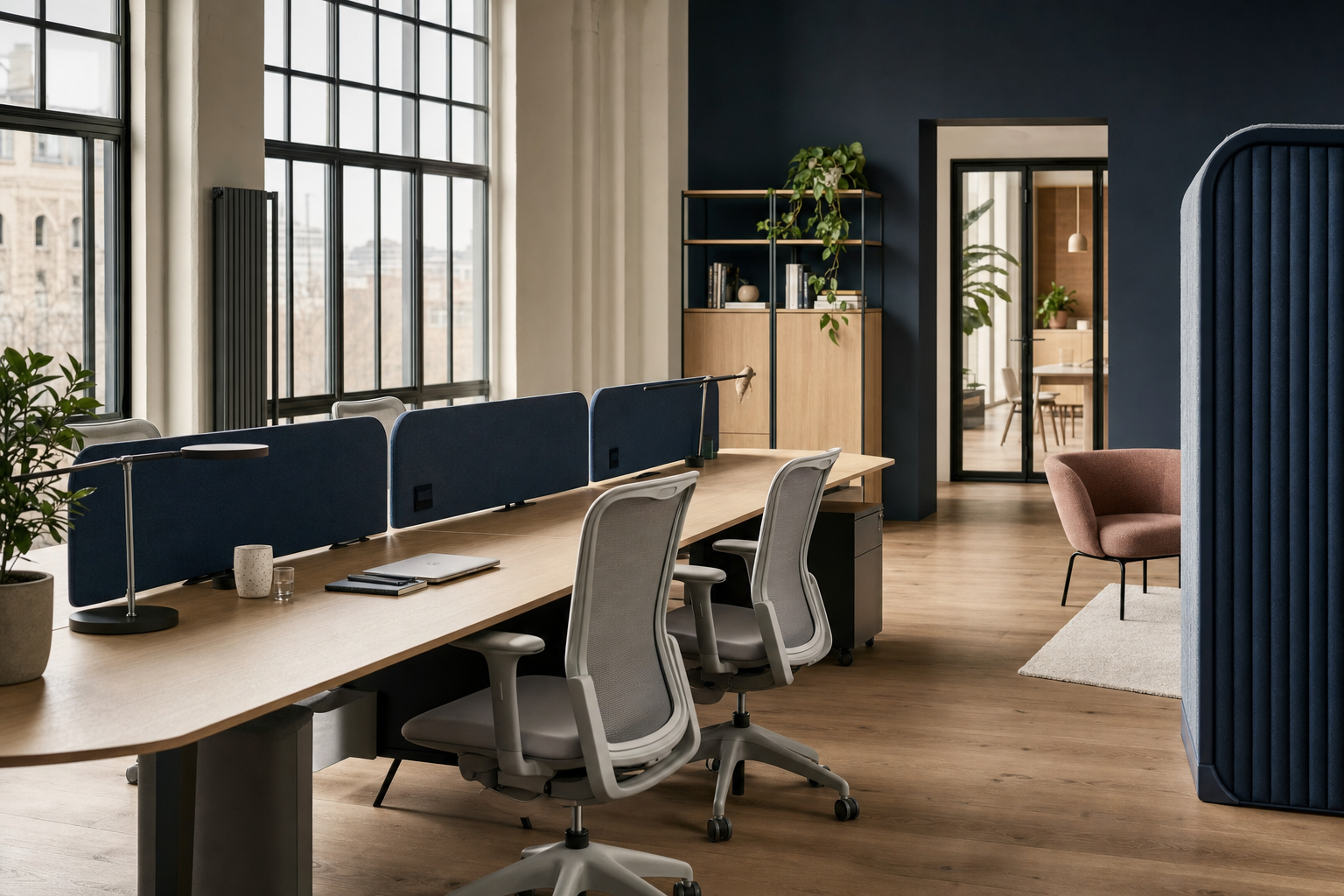
A hybrid office should be specified by zone, not by a single universal furniture list. For a workplace of around 60 to 80 desks, the focus area should start with BS EN 16139 non-domestic seating and BS EN 527 desks, because those standards keep the brief anchored to contract-grade use rather than domestic-looking product. A 1.4-metre module works well for planning desk runs, cable management, and acoustic screening where the office is supporting multiple weekly attendance patterns.
The wrong assumption is that every desk is equal. The better approach is to match the product to how heavily that zone is used.
Collaborative areas need a different logic. Mobile tables and stools are better suited to fast reconfiguration, and non-domestic table performance should be checked against the appropriate contract standard rather than chosen for appearance alone. Breakout zones should then use soft seating with the same durability logic, plus acoustic pods where video calls are part of the normal workday rather than an occasional exception.
Reception deserves the highest design discipline, because visitors read the space fast and form an impression before any meeting starts. The bench, side seating, and coffee table should be contract-grade, with upholstery and surface performance specified for the level of traffic that zone gets, and the same spacing discipline used for outdoor or hospitality-style overflow areas applies just as much to a reception zone that has to handle peaks in visitor flow.
A procurement checklist should always ask for warranty terms, upholstery performance, and reuse potential for each zone. That's where Enky's office space planning guide becomes useful, because good zoning is really about matching intensity of use to furniture life, not just filling floor area.
Certified European Furniture as a Risk-Reduction Tool
Certified, repairable European contract furniture is more than an ESG preference. It reduces programme risk. The common failure point is substitution, where a specified product gets swapped late, the replacement doesn't match the original performance brief, and the snagging list gets longer because the site team is now resolving hidden differences rather than installing a settled package.
That is why the spec should be written around traceable supply and repairability. FSC or PEFC chain-of-custody documentation helps the procurement team keep provenance clear, while replaceable components such as arms, castors, gas lifts, and foam make the piece easier to maintain over a lease cycle. A durable European frame also tends to hold residual value better at exit, which is why circular purchase and leaseback structures prefer these products in the first place.
Procurement rule: if the supplier can't document what gets replaced, maintained, or recovered, the furniture brief is incomplete.
The same evidence supports reporting and compliance. BREEAM In-Use and CSRD Scope 3 reporting are easier to defend when the office team can show material traceability, repair logic, and a clear product register. For emissions-related screening, the brief should also ask for EN 16516 emissions performance and Environmental Product Declarations on the top three SKUs, so the team is not trying to reconstruct evidence after handover.
The operational benefit is straightforward. Better-documented furniture shortens procurement disputes, lowers the chance of mid-project substitution, and gives the workplace lead a stronger closeout file at the end of the lease.
Build, Snagging, Handover and End of Life Recovery
A fit-out does not really finish at practical completion. It finishes when the handover pack is complete, the snagging list is closed, and the furniture strategy has an exit route. On a live office floor, a misplaced glazed acoustic screen can still happen if the procurement schedule is tied to an outdated GA drawing, and the fix is only clean when the contract already includes a clause for drawing control and substitution approval.
The build phase should run with weekly client walks, M&E commissioning checks, and a disciplined snag log. BSRIA BG6 is the relevant reference point for commissioning behaviour, but the main operational point is simpler, someone has to own the asset register, tag the FF&E against the original schedule, and make sure the O&M manuals and as-built drawings match what was installed. Without that, the handover pack becomes a filing exercise instead of an operational tool.
The final step is to treat end-of-life recovery as a lease-end obligation from the start. If a circular buy-back or recovery agreement is signed at procurement, the operator is not trying to negotiate disposal under pressure later. Residual value can then flow back into the next tenant cycle, which is exactly how a fitted office stops behaving like a write-down and starts behaving like a managed asset.
Enky supports office interior fit-out programmes with furniture access models that fit the lease term, the refurbishment cycle, and the exit plan. For UK operators comparing subscription, circular purchase, or leaseback, the right starting point is the FF&E strategy, not the final styling board. Visit Enky to review the workspace offer and align the furniture brief with the project programme.


