


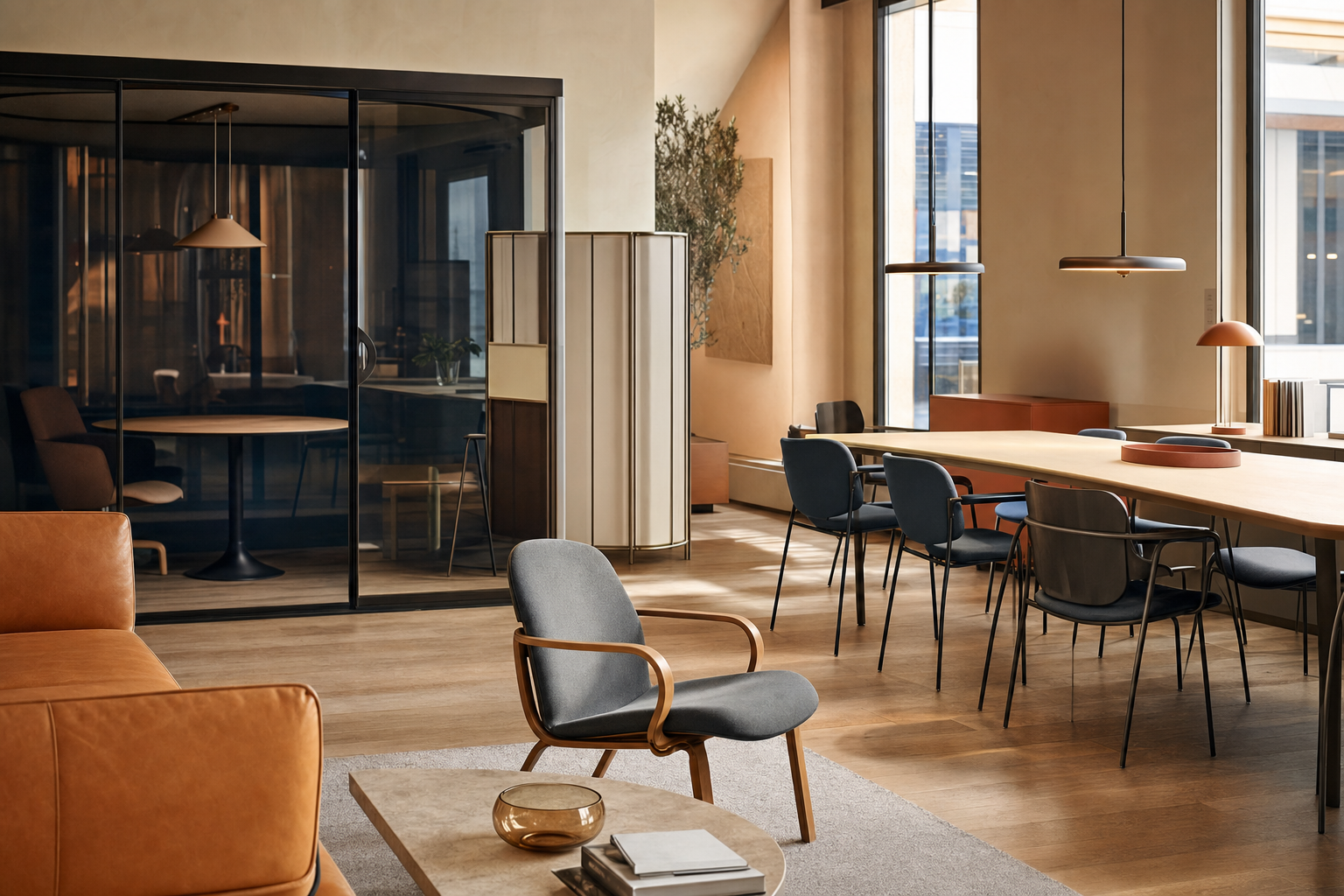
A facilities manager can have a full brief, a signed lease, and a premium spec ready to go, then discover the problem is cash structure. A hotel operator can love the furniture, need the furniture, and still not want to tie up capital in pieces that may be refitted next season. That is where leaseback vs subscription furniture stops being a terminology exercise and becomes a balance-sheet decision.
The split is simple, but the consequences aren't. Subscription furniture suits spaces that need flexibility from day one, while leaseback suits furniture that already exists on site and can be turned back into liquidity. In practice, the wrong model can leave a business either overcommitted on CAPEX or paying for complexity it didn't need. Enky sees that gap often in workspace, hospitality, and hybrid-use projects, where the right answer depends on what the business already owns, how fast it's growing, and who's responsible for the next move.
Table of Contents
- The Decision a Paris Scaleup Faced
- What Leaseback and Subscription Actually Are
- Cashflow, Tax and Balance-Sheet Impact
- Maintenance, Repairs and End-of-Life
- Which Model Fits Which Client Profile
- Enky's Circular Approach to Furniture Access
- Decision Framework and Next Steps
- Frequently Asked Questions
The Decision a Paris Scaleup Faced
When Enky furnished the Paris office of Dalenys, a growing payments company, the team had the brief, the lease, and the pressure to open quickly, but no existing furniture assets to monetise. That meant leaseback was never really on the table, because leaseback only works when there's something already on the balance sheet to convert into cash.

Starting from zero changes the answer
The company chose subscription furniture instead. That gave the team a fully specified workspace from day one with zero upfront CAPEX, and the model freed around €150,000 in working capital that an outright purchase would have absorbed, exactly when that cash had better uses. The full story is on the Dalenys case page. What mattered more than the label on the contract was the constraint itself: timing and liquidity, not ownership philosophy.
Practical rule: if there's nothing installed yet, leaseback doesn't unlock anything. It can only release value from assets that already exist.
A pattern like this comes up often in startups, coworking spaces, and hospitality openings. The question isn't whether furniture should be owned forever or never owned at all. The question is whether the business is trying to free cash from an installed base, or avoid locking cash into a new one.
For a buyer comparing leaseback vs subscription furniture, that starting position matters more than the catalogue. A new office with no assets points toward subscription. A property with a fully owned fit-out points toward leaseback. The wrong starting assumption creates hidden costs later, usually when the room needs to change and the finance team wants the numbers to stay clean.
What Leaseback and Subscription Actually Are
The market signals point in two different directions, and both are relevant. Future Market Insights projects the furniture rental and subscription market to grow at 10.2% a year in the UK and 8.5% in France between 2025 and 2035, while sale-and-leaseback activity in the wider asset market has been growing as businesses look to release capital from what they already own. Those trends don't describe the same mechanism, but they do show the same commercial instinct: businesses want capital to stay available.
Different structures, different job to do
Subscription furniture is usually an OPEX model. The customer pays a predictable monthly fee, the furniture isn't booked as a purchased asset, and services are bundled into the arrangement, including delivery, assembly, maintenance, and end-of-life recovery. That makes it closer to furniture as a service, which is about access and lifecycle management rather than ownership.
Leaseback, by contrast, is a capital-release structure. The business sells furniture it already owns, receives a lump sum, and keeps using the pieces under a lease. That's why leaseback is better suited to an installed asset base, while subscription is better suited to fit-outs that are still being assembled.
Subscription answers, "How do we furnish this space without heavy upfront spend?" Leaseback answers, "How do we free up cash from what's already here?"
A simple side note helps here. Enky treats subscription as monthly access with bundled service, as set out in Enky's subscription model, while leaseback is a way to convert existing furniture into working capital, up to 90% of the furniture's value, while keeping it in use. That difference is structural, not cosmetic.
Cashflow, Tax and Balance-Sheet Impact
A financing team looking at desks, chairs, and meeting tables usually wants the same answer first: how much cash leaves the business now, and what sits on the balance sheet afterwards. Under UK VAT rules for hire or leasing-style supplies, VAT is generally accounted for on each periodic instalment rather than being front-loaded at the start of the contract, and the tax point is usually tied to delivery or collection unless an invoice is issued within 14 days of that basic tax point (HMRC VAT timing rules). That matters because subscription behaves like a recurring operating outflow, not a one-off purchase spike.
OPEX on one side, capital release on the other
A furniture subscription is typically treated as operating expenditure rather than capital expenditure. The customer pays a predictable monthly fee, the furniture isn't booked as a purchased asset, and the cost is expensed over time rather than depreciated as owned stock. Leaseback works differently. It creates immediate liquidity from furniture already owned, then converts that liquidity into lease payments over time.
For a fit-out that is still being assembled, subscription usually fits the cash profile better because there is no owned asset to monetise. For an occupied office with installed furniture, leaseback can turn existing items into working capital without changing the day-to-day use of the space. That distinction matters in practice. If there is nothing installed yet, leaseback does not free up capital, and the business is left comparing a financing structure with a purchase it has not made.
A practical 3-year comparison is useful here, at the structural level rather than the decimal level. Subscription runs the full contract value through predictable monthly OPEX with maintenance and end-of-life recovery bundled in. Leaseback front-loads a lump-sum cash injection, up to 90% of the furniture's value, and then spreads lease payments over the term. The headline totals aren't the whole story either way, because leaseback clients still carry considerations such as depreciation history and eventual removal logistics unless buy-back or recovery terms are negotiated upfront. For a fuller discussion of the structure, Enky's leaseback model is the relevant reference point.
Tax and accounting treatment need their own check. The recognition of lease commitments depends on the contract and the accounting standards that apply to the business, and the details are worth confirming with the company's accountants and tax advisors rather than assumed from a comparison article. A structure can be attractive on cash timing and still create complexity elsewhere.
| Criterion | Subscription Furniture | Leaseback Furniture |
|---|---|---|
| Cash profile | Predictable monthly OPEX | Immediate cash injection, then lease payments |
| Ownership | No purchased asset booked | Existing assets converted into a lease structure |
| Balance sheet effect | Lower upfront capital commitment | Releases capital tied up in owned furniture, up to 90% of its value |
| VAT timing | Generally periodic instalments | Depends on the structure, worth confirming case by case |
| Best use case | New fit-outs, changing headcount, refresh cycles | Installed assets already on site |
The balance-sheet question usually decides the meeting. Subscription keeps the spend in operating terms and avoids adding owned furniture to the asset base, which is helpful when the business wants flexibility or expects churn in headcount and layout. Leaseback is more specific. It suits a company that already has furniture on site and wants to convert that trapped value into cash while continuing to use the same items.
An accountant might prefer one model and an operator another, but the final choice usually comes down to where the cash sits and how much control the business wants over the asset life cycle. If the furniture has not been bought yet, subscription protects cash. If it has already been bought, leaseback can turn that stock into liquidity without changing the workplace overnight.
Maintenance, Repairs and End-of-Life
Operational friction is where many furniture contracts either feel easy to run or turn into a constant nuisance. Under a subscription contract, repair and refurbishment sit inside the monthly fee, so worn units are typically triaged and swapped within the maintenance window at no extra cost. That flexibility is real in practice: at RP France's Poitiers office, the subscription model let the team swap chairs mid-contract as needs became clearer, without a separate procurement cycle or a write-off.
Service scope changes the day-to-day burden
Leaseback shifts that responsibility the other way. Maintenance is usually negotiated as an add-on rather than bundled, so a damaged sofa under a leaseback arrangement typically means a separate service call-out billed outside the lease terms, unless support was written into the agreement upfront. Neither model is wrong. They shift responsibility in different directions, and that difference shows up first in who answers the service ticket, then in who pays for the fix.
A facility team that wants one vendor relationship, one maintenance process, and a clear swap path for worn items will usually find subscription easier to run. A team with in-house vendor management and a clear internal process for repairs can make leaseback work, but only if the service scope is written in plain language from the start, especially for items that see daily use and occasional damage.
A meeting table is a useful example because it sits in the middle of procurement, operations, and end-of-life planning. Actiu's Dorik Meeting Table - Oval 240x120 H74 shows how a single piece can sit inside a broader commercial furniture plan, while the contract model still decides who handles servicing, replacement, and eventual removal. The asset may look straightforward on the floor, yet the operational burden depends on the contract text.
End-of-life terms matter just as much as repairs. If a contract keeps ownership and take-back within one circular route, the business has a clearer path for reuse, refurbishment, or redeployment, which aligns with the logic set out in Enky's circular economy furniture approach. If the furniture is expected to leave the site at the end of the term, the handback clause needs to say who collects it, what condition is accepted, and whether the client pays for disposal or restoration. That is often the point where the difference between access and ownership becomes visible.
The contract text decides who carries the friction, who controls the repair path, and how cleanly the furniture can re-enter circulation.

Which Model Fits Which Client Profile
The right answer depends on what the organisation already owns, how quickly it needs flexibility, and how much control it wants over the furniture at the end of the term. A Paris scaleup with no installed base starts from a different position than a boutique hotel group that already owns a full fit-out, and that difference changes the decision.
Match the model to the asset lifecycle
Subscription fits startups and scaleups furnishing new spaces, especially when there is no furniture in place yet. As the Dalenys case shows, subscription gives a team a complete workspace from day one and lets the furniture mix follow hiring rather than precede it. It also suits boutique hotels and co-living operators that refresh rooms or common areas often and want costs they can plan around.
The other side of the split is easy to picture. As an illustration, consider a hotel group that furnished its first property with opening capital and now needs cash for renovation at a second site. The furniture is installed, owned, and working; the constraint is liquidity, not layout. That's the profile where leaseback becomes the sharper tool. The trigger is a liquidity event, not a problem with subscription, and the contract model should follow the asset history, not the other way around.
A practical way to separate the models is simple:
- No existing assets, new fit-out, or a growing team: subscription is usually the cleanest starting point.
- Owned furniture, stable installation, need for liquidity: leaseback becomes relevant.
- Long-term ownership with planned recovery: circular purchase can sit between the two.
For residential developers, the choice often turns on whether the fit-out is intended to be replaced at turnover or retained as a long-life asset. For hospitality and office operators, the question is how long the space will stay stable before the furniture strategy changes. That is why leaseback vs subscription furniture is not a brand preference question. It is an asset-lifecycle question tied to balance-sheet impact, contract length, exit terms, residual value, and what happens when the furniture leaves the site.
A fit-out can look identical on day one and still belong in a different contract model by day thirty. The useful question is not which option sounds better. It is which one matches the client's ownership position, cash needs, and end-of-term plan.
Enky's Circular Approach to Furniture Access
Enky's model treats subscription, circular purchase, and leaseback as part of one circular system, rather than as separate offers. The practical difference sits in end-of-life handling, because recovery, refurbishment, and redistribution are designed into the access model from the start. That matters in workspace, hospitality, and residential projects where furniture should keep moving through use instead of stopping at disposal.

Three access models, one circular loop
That loop depends on the furniture itself. Certified European brands such as Pedrali, Alki, Muuto, Framery, Softline, and Lapalma sit at the centre of the offer, with FSC/PEFC and OEKO-TEX traceability where relevant. Modularity and repairability are not extra features here. They are what make a second cycle realistic when a project changes hands, gets refurbished, or needs parts replaced.
The scale of the model shows how it works in practice. Enky has delivered 180+ projects, supports 5,000+ daily users of its furniture, and estimates it has avoided around 1,990 tonnes of CO2e emissions through that circular loop. The wider structure also includes Enky Invest, where individuals can invest in furniture projects for target returns of up to 9%, paid monthly. As with any investment, capital is at risk and returns are not guaranteed. For operators and investors, the point is straightforward: furniture is treated as an asset-backed category with a planned recovery path, not as disposable fit-out spend.
For a broader explanation of how reuse and recovery shape that approach, see Enky's circular purchase model. The useful difference is in the end-of-life mechanics, because the furniture is expected to come back into circulation, not leave the system at contract end.
The practical takeaway is simple. Subscription fits use-based access, circular purchase fits ownership with recovery in mind, and leaseback fits liquidity against furniture already in place. Enky ties those paths to the same recovery logic, so the decision is not only about getting furniture in the room, but about what happens when that room changes.
Decision Framework and Next Steps
The decision usually becomes clear when three questions are answered in order. First, does the business already own furniture it wants to convert into cash? If yes, leaseback is the direct route. If no, subscription is the starting point.
Three questions that cut through the noise
Second, does the business care more about balance-sheet flexibility or operational simplicity? Subscription bundles maintenance and recovery into one monthly payment. Leaseback frees capital, but the service side often needs separate coordination unless support terms are negotiated upfront.
Third, what is likely to happen over the next 24 to 36 months? If headcount or room count may shift materially, subscription can scale with that change. If the asset base is stable and the goal is to monetise it, leaseback captures the value already sitting in the furniture.
Rule of thumb: new fit-out, no assets, use subscription. Owned assets, need liquidity, consider leaseback. Long-term ownership with built-in recovery, look at circular purchase.

Enky also adds project support for architectural and design coordination, which matters when a furniture decision is tied to layout, acoustics, or a phased opening. The next step isn't a commitment. It's a conversation about which assets already exist, which ones need to stay flexible, and which structure keeps cash working harder.
Frequently Asked Questions
Is subscription furniture cheaper than buying?
Not always, and not in every time horizon. Buying can look cheaper if the comparison ignores maintenance, storage, replacement, and disposal. Subscription can look more expensive if the buyer only looks at sticker price and not the cost of managing the furniture through its whole life.
Can leaseback work if the furniture is brand new?
Yes, if the furniture is already owned by the business and has value to release. The age of the furniture matters less than the fact that it exists on the balance sheet and can be monetised. If there's nothing owned yet, leaseback doesn't solve the funding problem.
What happens if the space changes during the contract?
That depends on the model. Subscription is usually easier to adjust when layouts, headcount, or room use shift. Leaseback is more stable but can be less flexible unless the service agreement explicitly covers changes, repairs, or buy-back terms.
How does circular purchase fit into this comparison?
Circular purchase is the middle ground. It gives ownership from day one, but recovery and next-life planning are built into the structure. That's useful when a business wants control without ending up with stranded furniture later.
Which model works better for a hotel opening?
If the hotel is furnishing from scratch and wants to avoid a large opening cash hit, subscription usually fits better. If the hotel already owns furniture and needs working capital for renovation or another property, leaseback can be the sharper tool.
Enky structures premium furniture around subscription, circular purchase, and leaseback, so facilities and finance teams can match the model to the asset, not the other way round. For a new office, a hotel refresh, or a portfolio decision, the fastest next step is to review the furniture already in play and the cash position behind it. Visit Enky to explore the catalogue and compare the access model that fits the space.


