


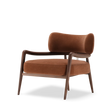
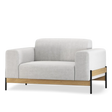
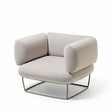
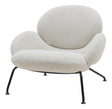
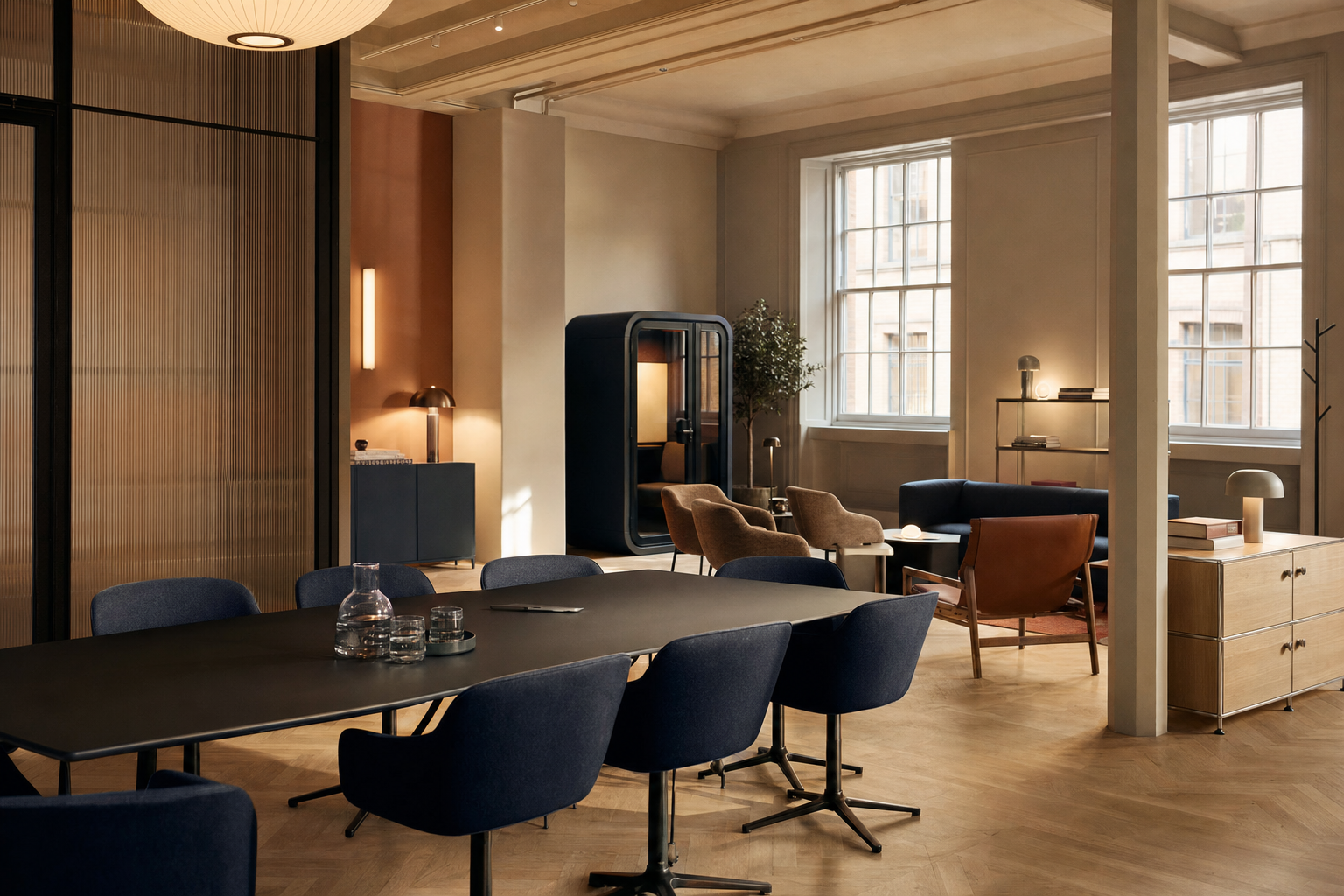
A familiar UK buying situation looks like this. A founder has signed a new office, a boutique hotel is reopening a lounge, or a co-living operator needs to furnish several units quickly. The search starts with furniture hire UK, and the results are full of banquet chairs, poseur tables, and weekend event stock. That solves a wedding. It rarely solves a workspace or hospitality project that needs to perform for months, not days.
That gap matters because the demand has moved. Future Market Insights projects the UK furniture rental and subscription market to grow at 10.2% a year between 2025 and 2035, and the growth is increasingly driven by long-term, business-led use rather than event hire. That points to a structural shift in how offices, hotels, and flexible living spaces are being furnished.
Short-term hire is built for transactions. Professional interiors need a system. They need design consistency, durable pieces, maintenance, asset recovery, and a model that fits cash flow. That's where the UK conversation is changing, from renting furniture as a temporary patch to using flexible access as an operating strategy.
Table of Contents
- Beyond Basic Rental: The New Landscape of Furniture Hire in the UK
- Furniture Subscription: A Strategic Alternative to Hiring
- Creating Value with Circular and Asset-Light Models
- The Advantage of Design-Led Sustainable Office Furniture
- The Enky Model: A Synthesis of Flexibility and Circularity
-
Frequently Asked Questions
- Is furniture hire UK still the right option for a normal office move?
- What term should a business expect with furniture subscription?
- Is sustainable office furniture always more expensive?
- What should buyers ask before signing with any furniture rental UK provider?
- Can a hospitality project mix models instead of choosing only one?
Beyond Basic Rental: The New Landscape of Furniture Hire in the UK
The UK market is growing because buyers need more than emergency furniture. The strongest demand now comes from ongoing occupancy, which fits the way startups, boutique hotels, co-working operators, and residential projects work.
Search results still lag behind that reality. Most visible providers focus on short-term events, single-item lists, and basic logistics. That model is useful when the brief is simple. It breaks down when the brief includes acoustics, staff comfort, brand positioning, phased occupancy, or the need to reconfigure a floorplate six months later.
Where traditional hire works
There are situations where classic furniture rental UK services still make sense:
- Short event windows: Product launches, receptions, weddings, and temporary pop-ups.
- Simple functional needs: Extra seating, tables for overflow, or stop-gap pieces during a move.
- Low design sensitivity: Spaces where visual consistency and long-term durability don't matter much.
Where it starts to fail
A business furnishing a real operating space usually needs something else.
| Need | Traditional event-style hire | Long-term strategic model |
|---|---|---|
| Duration | Built for short use | Built for ongoing use |
| Design quality | Often generic | Usually curated and brand-aligned |
| Maintenance | Limited | Structured into the model |
| Flexibility | Transactional | Scalable over time |
| End-of-life | Often unclear | Recovery can be planned |
The key trade-off is simple. Short-term rental reduces immediate friction, but it often increases operational friction later.
That's why furniture hire UK now sits inside a broader decision. The key question isn't only "what can be delivered next week?" It's "what furnishing model supports the space for the next year or two without locking too much capital into depreciating assets?"
Furniture Subscription: A Strategic Alternative to Hiring
For businesses furnishing an office, hotel lounge, or flexible residential scheme, furniture subscription is often a better tool than conventional hire. It treats furniture as an operating service rather than a one-off procurement exercise, which changes both the financial logic and the operational experience.
Why subscription changes the decision
Traditional hiring is usually designed around fixed inventory and fixed delivery windows. Office furniture leasing can be more structured, but it can also become rigid. Subscription sits in the middle with more flexibility and better design control.
As an illustration, take a 50-person startup moving into its first proper London office. Buying everything upfront pushes a large furnishing decision into CAPEX at exactly the moment leadership wants to preserve cash for hiring, product, and growth. Short-term hire avoids the purchase, but it often leaves the team with furniture that looks temporary and performs like it.
With a furniture subscription model, monthly access replaces a large upfront outlay with a predictable operating payment. The exact accounting treatment depends on contract terms (longer agreements are typically recognised as a right-of-use asset under IFRS 16), but the consistent benefit is lower upfront capital and better cash-flow timing. That matters because offices rarely stay static. Headcount changes. Teams shift from fixed desks to mixed collaboration zones. A meeting room becomes a content studio. The furniture model has to absorb that movement.
Good, better, best
- Good: Traditional rental for very short occupancy or temporary gaps.
- Better: Conventional leasing when the specification is stable and the term is clear.
- Best for dynamic spaces: Subscription where layout, team size, and use cases are likely to change.
Practical rule: If the business expects the space brief to change before the furniture reaches the end of its life, ownership is often the least flexible option.
What buyers should check
Not every subscription offer is worth taking. The useful questions are operational:
- Model fit: Can the range support desks, ergonomic chairs, lounge seating, meeting tables, and acoustic elements together?
- Service scope: Is maintenance included, or does the client still manage wear, repairs, and replacements?
- Exit logic: Is there a clear route to recovery, upgrade, or purchase if the project evolves?
- Design quality: Are the pieces suitable for a professional environment, or do they still feel like event stock?
Clearly, furniture hire UK is no longer only a logistics search. For offices and hospitality, it's increasingly a question of adaptability, cash preservation, and whether the furniture can evolve with the business instead of slowing it down.
Creating Value with Circular and Asset-Light Models
Many UK searches for furniture hire still lead to event stock, short terms, and basic delivery logistics. That leaves a gap for offices, aparthotels, and boutique hospitality projects that need furniture to perform for years, while still giving operators room to change course.

Leaseback for operators with capital tied up in furniture
A business can have usable furniture on site and still be carrying too much capital in it. A leaseback model for existing furniture assets gives finance and operations teams another option. Keep the furniture in use, improve cash position, and avoid a disruptive full replacement.
The trade-off is straightforward. Leaseback only works if the installed furniture still has real service life, a coherent specification, and enough quality to justify remarketing or continued circulation later. If the estate is tired, inconsistent, or heavily damaged, the model becomes harder to structure well.
This tends to suit established operators more than first occupiers. Hotel groups, serviced offices, and mature companies often have better furniture than their balance sheet strategy suggests.
Circular purchase for buyers who still want ownership
Ownership still makes sense in some projects. A flagship office, a long-stay hospitality scheme, or a site with a fixed design brief may prefer to buy. The stronger version of that decision is circular purchase, where recovery, refurbishment, and resale or reuse are considered at the specification stage, not left as a disposal problem at the end.
That changes how products should be assessed. Materials matter. Repairability matters. Whether a piece can move between settings matters.
The Boldini Coffee Table 46x42 H28/40 cm shows the difference between design-led commercial furniture and generic temporary stock. Its sculptural form, material options such as selected marbles or glossy travertine and glazed ceramic, and dual-height geometry at 28 and 40 cm make it suitable for lounges, terraces, and mixed hospitality settings. Custom-fit rain covers also make the specification more practical for outdoor use over time, not just attractive on delivery day.
The operational detail buyers often miss
Circularity succeeds or fails in handling. A table that looks right in a showroom can lose value quickly if it is moved badly during churn, storage, or phased installation.
Teams managing decants, refurbishments, or interim storage should plan for protection as carefully as they plan for procurement. Padded blankets, edge protectors, and disciplined handling during transport and storage reduce edge damage, surface marking, and avoidable wear, and they protect exactly the residual value that circular models depend on.
A furnishing model only works if the exit route works too. Recovery, refurbishment, and reallocation need to be built into the operating plan from day one.
The Advantage of Design-Led Sustainable Office Furniture
The broader supply picture supports a more ambitious approach. CSIL values the European office furniture market at more than €9.5 billion in 2025, with rising demand for refurbished furniture, which means businesses aren't limited to generic stock or disposable fit-out thinking. There's depth in the supply chain. The main question is whether that supply is being curated properly for workspace and hospitality use.

Why design quality matters in working spaces
Cheap temporary furniture creates visible and hidden costs. It can undermine brand perception, age quickly, and make teams treat the office as a holding space rather than a place built for focused work. That's especially obvious in hybrid offices, where every in-person day needs to justify the commute.
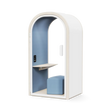
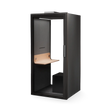
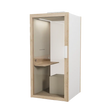
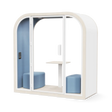
A better specification usually includes a mix of ergonomic chairs, meeting tables that support varied group sizes, lounge seating that can absorb informal work, and acoustic solutions that reduce friction. Framery phone booths are a clear example. In a hybrid office with frequent calls, acoustic furniture solves a genuine operational problem. It isn't decorative. It protects concentration and privacy.
Hospitality has even less room for compromise
Hotels, restaurants, and co-living projects have to perform visually from day one. A lobby furnished with generic rental pieces looks temporary, even when the operator plans to keep the setup for a year. That's why design-led collections from brands such as Pedrali, Muuto, Alki, Softline, and Lapalma matter. A Pedrali dining chair in a boutique hotel breakfast room does more than provide seating. It helps define the tone of service, quality, and permanence.
For hospitality buyers considering circular purchase options, the strongest specifications usually combine three things:
- Certified materials: FSC/PEFC timber and OEKO-TEX textiles where applicable.
- Repairability: Components that can be maintained or replaced instead of discarded.
- Modularity: Systems that can adapt to layout shifts or seasonal use.
Sustainable office furniture isn't only about material claims. It's about whether the product can stay useful, attractive, and serviceable over time.
What works in practice
- For hybrid offices: Ergonomic desks and chairs paired with acoustic booths and soft seating.
- For boutique hotels: Dining chairs, bar stools, lounge pieces, and lighting that feel coherent across guest touchpoints.
- For co-living schemes: Durable modular sofas, shelving, and tables that can handle frequent turnover without losing visual consistency.
- For restaurant terraces: Outdoor-rated pieces with clear maintenance logic rather than improvised indoor products moved outside.
Furniture rental UK often diverges into two paths. One path is temporary stock. The other is a proper interior strategy built on durable, European-made pieces, certified materials, and a clear lifecycle plan.
The Enky Model: A Synthesis of Flexibility and Circularity
Enky launched in the UK in October 2024, a move covered by Sustainability Magazine's report on the company's zero-waste subscription model, after building its Furniture as a Service offer across Belgium, France, Switzerland, and Spain. The demand it responds to says something important about the market. Businesses aren't only looking for furniture. They're looking for an asset-light way to furnish well without sacrificing optionality.

At Enky, the model is built around three connected routes rather than a single sales logic. Subscription supports businesses that want monthly access and flexibility. Circular purchase suits projects that want ownership with end-of-life recovery integrated. Leaseback gives operators a way to extract value from existing furniture assets while keeping them in use.
Why the combined model matters
Most suppliers force the buyer into one decision. Buy everything. Rent everything. Replace everything later. That's rarely how real projects work.
A workspace might use subscription for desks and ergonomic seating because headcount is changing, circular purchase for a reception desk or statement meeting table because the brand wants permanence, and leaseback on existing assets that still have value. That's exactly how WorkPad, a London serviced-office operator, furnished its Newman Street site: a split model, leasing for the fitted spaces and subscribing for the flexible layer, with 347 pieces delivered on schedule. Hospitality projects can work the same way, especially during staged openings or refurbishments.
What makes this different from standard furniture hire UK offers
At Enky, the catalogue is structured around workspace, hospitality, and residential use rather than event stock. It includes European-made brands such as Pedrali, Alki, Muuto, Framery, Softline, and Lapalma, with attention to modularity, repairability, FSC/PEFC wood, and OEKO-TEX fabrics where applicable. The company was co-founded by Aïssa Laroussi and is headquartered in Brussels, with activity across Belgium, France, Switzerland, Spain, and the UK.
The wider platform also matters. According to Enky's own reported figures, the company has delivered Enky figures not cited in this article, supports 5,000+ daily furniture users, and estimates it has avoided more than 1,990 tonnes of CO2e emissions. Alongside the furnishing activity, Enky Invest lets individuals and wealth managers invest in furniture projects, with target annual returns of up to 9% as presented on the Enky Invest page; as with any investment, capital is at risk and returns are not typically. For readers evaluating furniture as an asset-backed category rather than only a procurement line, that broader ecosystem is part of the proposition.
Frequently Asked Questions
Is furniture hire UK still the right option for a normal office move?
It can be, but only for a narrow use case. If a business needs furniture for a short holding period, such as a temporary swing space during works, classic hire is still useful. For offices expected to run in place for a year or more, a subscription or lease structure usually makes more operational sense because the furniture needs to perform under daily commercial use, not solely for covering an immediate gap.
What term should a business expect with furniture subscription?
The term is usually longer than event hire because the service is built around real occupancy, installation, and ongoing use. Terms of around a year are a common starting point in the market. That aligns better with office planning cycles, hotel openings, phased refurbishments, and team changes than a week-by-week rental model.
Is sustainable office furniture always more expensive?
Not in any meaningful buying assessment.
Lower upfront pricing can look attractive, but cheap commercial furniture often creates higher replacement, repair, and disposal costs later. Better-made products with certified materials, replaceable parts, and a clear recovery route usually hold up longer and create fewer procurement problems over the life of the space.
What should buyers ask before signing with any furniture rental UK provider?
Start with the operating questions, not the day rate. Buyers should ask:
- What happens if headcount changes or the layout is revised?
- Who is responsible for maintenance, damage, collection, and end-of-term logistics?
- Is the furniture specified for everyday office or hospitality use, or mainly for events and short-term functions?
If those answers are vague, the client usually carries more risk than the quote suggests.
Can a hospitality project mix models instead of choosing only one?
Yes. In practice, many of the better projects do.
A hotel might buy front-of-house pieces that define the brand, use subscription for guest room furniture during a repositioning phase, and use leaseback as a way to release capital from existing furniture assets that still have value. Momoamo's Domaine de Courtigis near Paris works exactly this way: circular purchase anchors the signature pieces across its five buildings, while a subscription layer keeps the shared spaces adjustable as the concept evolves. That structure gives operators more control over cash flow, timing, and design quality than a single procurement method applied across the whole site.
Businesses looking beyond short-term event stock can explore Enky for workspace, hospitality, and residential furniture through subscription, circular purchase, or leaseback, then review the catalogue and request a project conversation based on the space, term, and budget.


